American democracy isn't dying from a single dramatic blow—it's being bled to death by a thousand incremental cuts. Across Republican-controlled state legislatures, a coordinated campaign of voter suppression is quietly making your vote worth less with each election cycle, imposing what amounts to a "democracy tax" on citizens who dare to live in the wrong zip code, work the wrong hours, or lack the right documentation.
The numbers tell a stark story. Since the Supreme Court gutted the Voting Rights Act in 2013's Shelby County v. Holder decision, states have closed over 21,000 polling places, with the heaviest closures concentrated in communities of color. Texas alone has shuttered more than 750 polling locations since 2012, while Georgia closed 214 precincts between 2012 and 2018—nearly 8% of the state's total.
The ID Requirement Maze
Voter ID laws represent perhaps the most insidious form of this democracy tax. Proponents frame these requirements as common-sense fraud prevention, but the data reveals their true purpose: systematic disenfranchisement of Democratic-leaning constituencies. The Brennan Center for Justice estimates that 36 states now have some form of voter ID requirement, with 19 requiring photo identification.
The burden falls heaviest on those least able to bear it. Obtaining a "free" voter ID often requires documents that cost money—birth certificates can cost $25 or more—and time off work that hourly employees can't afford. In Alabama, the state closed 31 DMV offices in counties with high Black populations immediately after implementing its voter ID law, forcing residents to travel hours to obtain the documentation needed to vote.
Consider Wisconsin, where a strict photo ID law implemented in 2016 coincided with a 41,000-vote decline in Milwaukee County turnout compared to 2012. That's not coincidence—it's the democracy tax in action. Studies suggest the ID requirement alone may have depressed turnout by 200,000 votes statewide, in a state Trump won by fewer than 23,000 votes.
Polling Place Deserts
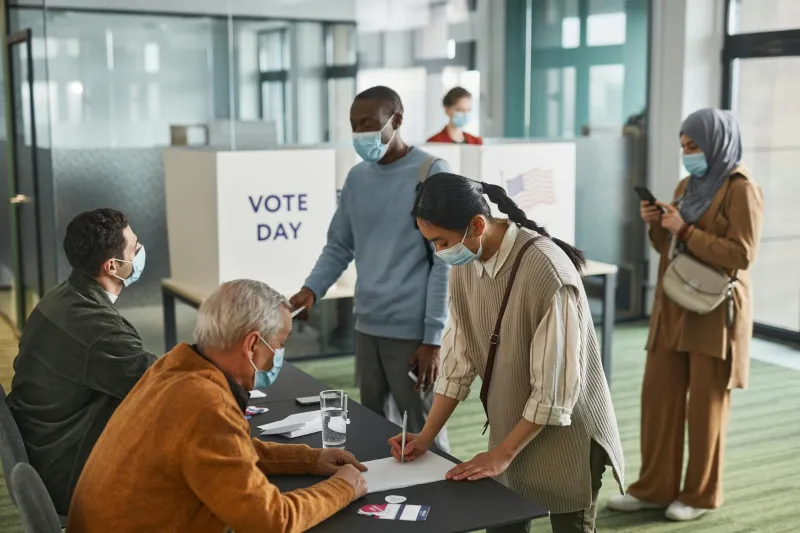
The systematic closure of polling places creates "voting deserts" that mirror food deserts in low-income communities. Since 2013, jurisdictions previously covered by the Voting Rights Act have closed polling places at nearly twice the rate of other areas. The pattern is unmistakable: affluent, white suburbs maintain convenient polling access while working-class communities of color see their voting infrastructure systematically dismantled.
In Dodge City, Kansas—a majority-Latino meatpacking town—officials moved the sole polling place outside city limits, requiring voters to travel past a highway and railroad tracks with no sidewalks. In Georgia's Randolph County, officials attempted to close seven of nine polling places in a county that's 61% Black. The message is clear: your vote is welcome, but only if you can overcome the obstacles we've placed in your path.
Gerrymandering's High-Tech Revolution
Perhaps most perniciously, modern gerrymandering has weaponized technology to achieve levels of partisan manipulation previously impossible. Sophisticated mapping software allows legislators to sort voters with surgical precision, creating districts that virtually guarantee electoral outcomes regardless of shifting public opinion.
The results speak for themselves. In 2018, Democrats won 53.4% of House votes nationwide but secured just 54% of seats—a modest advantage that should have been much larger. In states like North Carolina and Wisconsin, Republicans have maintained legislative majorities despite consistently losing the statewide popular vote. Wisconsin Republicans won 46% of Assembly votes in 2018 but secured 63% of seats—a 17-point distortion that makes a mockery of representative democracy.
The Counter-Narrative Crumbles
Republicans defend these measures as necessary safeguards against voter fraud, but this argument collapses under scrutiny. The Heritage Foundation, a conservative think tank, has documented fewer than 1,400 instances of voter fraud resulting in convictions since the 1990s—out of billions of votes cast. You're more likely to be struck by lightning than encounter voter impersonation fraud.
The real fraud is the systematic disenfranchisement of eligible Americans. When Texas's voter ID law was challenged in court, the state could produce exactly two cases of in-person voter fraud out of 20 million votes cast over a decade. Meanwhile, the law potentially disenfranchised 600,000 registered voters who lacked acceptable ID.
Human Cost of Democratic Decay
Behind these statistics are real people whose voices are being systematically silenced. Crystal Mason, a Black mother in Texas, received a five-year prison sentence for casting a provisional ballot while on supervised release—a ballot that wasn't even counted. Meanwhile, the architects of voter suppression face no consequences for undermining the fundamental right that underpins all others.
The democracy tax falls heaviest on those already bearing the greatest burden of economic inequality. Working parents who can't afford to take time off for a DMV visit. Elderly Americans whose decades-old birth certificates don't match current requirements. Students whose campus IDs aren't accepted while hunting licenses are. The pattern reveals the true intent: not preventing fraud, but preventing participation.
2026: The Stress Test
The 2026 midterms will serve as the clearest test yet of whether this coordinated assault on voting rights is working. With new voter suppression laws enacted since 2020 and redistricting maps drawn with unprecedented precision, Republicans are betting they can maintain power even as their policy agenda grows less popular.
This represents a fundamental threat to democratic governance. When politicians can choose their voters rather than voters choosing their politicians, policy becomes disconnected from public will. Climate action stalls despite overwhelming support. Gun safety measures die despite broad consensus. Healthcare remains unaffordable despite bipartisan concern. The democracy tax doesn't just suppress votes—it suppresses progress.
The solution requires both federal action and grassroots mobilization. The John Lewis Voting Rights Advancement Act would restore federal oversight of election changes in states with histories of discrimination. The Freedom to Vote Act would establish national standards for ballot access and redistricting. But these measures face Senate obstruction, making state-level organizing and litigation increasingly crucial.
Every closed polling place, every rejected ID, every gerrymandered district represents a choice to prioritize partisan advantage over democratic legitimacy—and that choice is bankrupting American democracy one vote at a time.