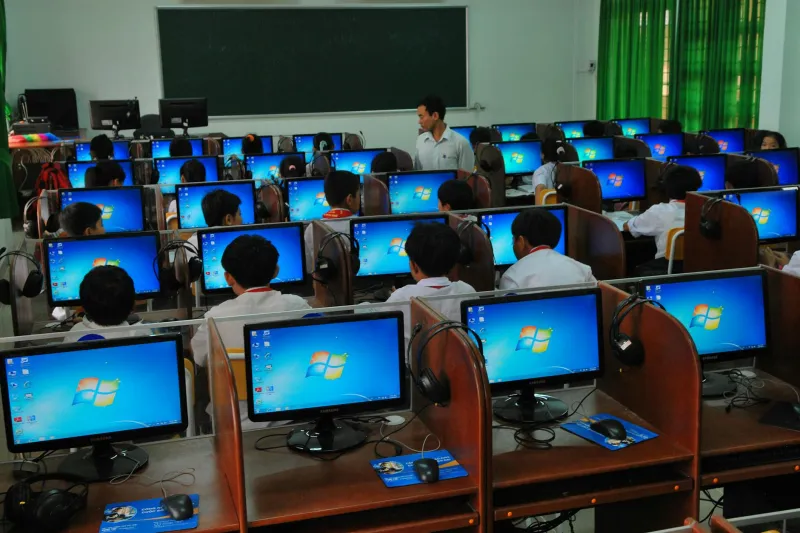
The Digital Panopticon in Every Classroom
Across America's 130,000 public schools, a quiet revolution has transformed how children learn—and how their most intimate developmental moments are captured, analyzed, and monetized. Educational technology platforms now monitor everything from how long a third-grader hesitates before answering a math problem to which emotional expressions a high schooler displays during a virtual lesson. What parents were told would personalize education has instead created the largest unregulated surveillance apparatus targeting minors in American history.
Google for Education alone operates in over 80 million student accounts worldwide, while PowerSchool manages data for 45 million students across 90 countries. Clever, which serves as a digital gateway for classroom apps, processes login data for over 50% of American K-12 students. These platforms don't just collect test scores—they harvest keystroke patterns, eye movements, facial expressions, voice recordings, location data, and detailed behavioral analytics that create psychological profiles more comprehensive than anything the FBI maintains on most adults.
The FERPA Loophole That Broke Student Privacy
The Family Educational Rights and Privacy Act, passed in 1974, was designed to protect student records in an era of paper files and guidance counselors. Today, it's a Swiss cheese law that tech companies drive data-harvesting trucks through. FERPA allows schools to share student information with any company providing "educational services"—a definition so broad it includes virtually every app, platform, and digital tool in the modern classroom.
Under this loophole, companies can collect data on students without parental consent as long as they claim an educational purpose. But there's no meaningful oversight of how that data is used, stored, or shared. A 2019 study by the Center for Democracy and Technology found that 89% of educational apps failed to clearly explain their data practices to parents, while 67% engaged in data sharing that would be illegal if applied to adults under existing privacy laws.
The Commodification of Childhood Development
What makes educational data particularly valuable—and particularly dangerous—is its intimacy and permanence. These platforms don't just know what students get wrong; they know how they think, how they struggle, and how they grow. Algorithms analyze hesitation patterns to infer anxiety levels, track social interactions to map peer relationships, and monitor engagement to predict future academic performance.
This data becomes the foundation for "personalized learning" products that schools then purchase—often from the same companies that collected the original data. It's a perfect circular economy: harvest intimate details about children's cognitive development for free, then sell those insights back to cash-strapped school districts as premium educational products. Google's "personalized learning" recommendations, for instance, are powered by the behavioral data the company extracts from student interactions across its education suite.
Beyond the Classroom: A Pipeline to Permanent Surveillance
The long-term implications extend far beyond education. Companies are building detailed psychological profiles that will follow students throughout their lives. College admissions, employment screening, insurance underwriting, and credit decisions could all eventually draw from databases that began capturing information when these children were in kindergarten.
Consider the trajectory: a student who struggles with reading comprehension in second grade generates data points about processing speed and attention patterns. By high school, machine learning algorithms have created a comprehensive cognitive profile. By college, that data could influence scholarship decisions. By age 30, it might affect mortgage approvals or job applications. What began as educational support becomes a permanent digital shadow that shapes life opportunities.
The Inequality Engine Hidden in Plain Sight
This surveillance infrastructure doesn't affect all students equally. Wealthy districts often have dedicated IT staff who can negotiate better privacy terms with vendors, while underfunded schools accept whatever data-sharing agreements come with "free" educational tools. Private schools increasingly opt out of the most invasive platforms, while public school students—disproportionately students of color and from low-income families—become the raw material for data extraction.
The result is a two-tiered system where privileged children's privacy is protected while working-class kids are subjected to algorithmic monitoring that would make China's social credit system blush. These same students are then labeled as "at-risk" or "low-performing" based on algorithmic analyses of data they never consented to provide.
The Resistance That Schools Won't Tell You About
Some educators are pushing back, but they face enormous institutional pressure. Teachers who question data collection are often told they're obstructing student progress or resisting innovation. Principals worry about losing access to popular platforms that teachers rely on. School boards, overwhelmed by technical complexity, defer to vendors who promise that data collection serves students' interests.
Meanwhile, other developed nations are taking action. The European Union's GDPR provides meaningful protections for student data, while countries like Germany have banned Google's education suite from public schools entirely. American children deserve the same protections that European law guarantees their peers.
 Photo: European Union, via logos-world.net
Reclaiming the Digital Classroom
The path forward requires acknowledging that educational technology and student privacy aren't mutually exclusive—but only if we demand better. Schools need explicit parental consent for any data collection beyond basic academic records. Companies should be required to delete student data when it's no longer needed for educational purposes. And FERPA needs a complete overhaul for the digital age, with enforcement mechanisms that actually protect children.
Most importantly, we must reject the false choice between educational innovation and student privacy. The same Silicon Valley companies that claim data collection is essential for learning somehow managed to develop revolutionary technologies for decades before they gained access to children's behavioral data.
The surveillance classroom isn't an inevitable feature of modern education—it's a business model that prioritizes corporate profits over children's fundamental right to cognitive privacy and developmental autonomy.