Bulletproof Backpacks and Blood Money: How the School Safety Industry Turned Mass Shootings Into a Market
Photo: Swartokm, CC BY-SA 4.0, via Wikimedia Commons
Sometime in the years between Columbine and Sandy Hook, a calculation was made — not in any single boardroom or policy meeting, but distributed across hundreds of companies, school district procurement offices, and state legislatures — that mass shootings in America were not a crisis to be solved but a market condition to be serviced. The result is an industry now estimated by analysts at more than $3.5 billion annually, built on the premise that children will continue to be murdered in their classrooms and that the appropriate response is not to prevent those murders but to sell the survivors better places to hide.
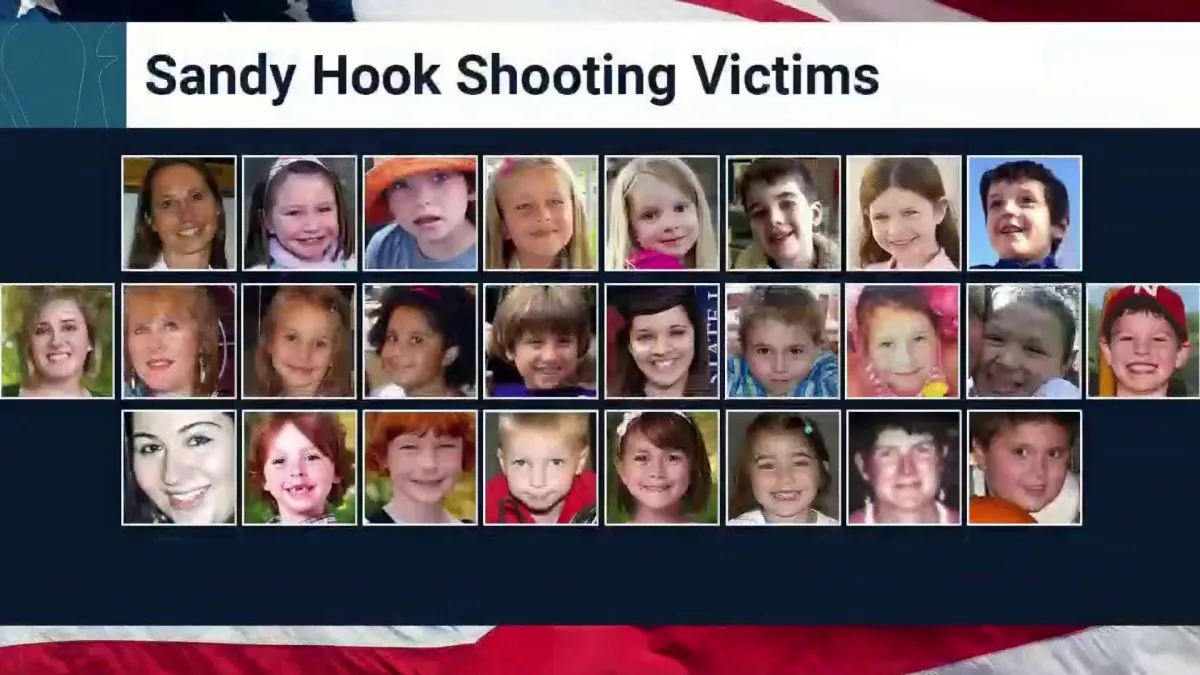 Photo: Sandy Hook, via media13.s-nbcnews.com
This is not hyperbole. It is the business model, stated plainly.
The Architecture of a Growth Industry
The school safety and security market encompasses a sprawling ecosystem of vendors: active shooter response training companies, crisis management consultants, school resource officer programs, ballistic-resistant classroom furniture manufacturers, facial recognition and behavioral surveillance technology firms, and the retailers selling bulletproof backpack inserts to parents who have run out of better options.
Following the 2012 Sandy Hook massacre, federal and state governments dramatically increased spending on school security infrastructure. The Every Student Succeeds Act, the STOP School Violence Act of 2018, and numerous state-level funding streams have collectively channeled billions of dollars into this market. The Department of Homeland Security's School Safety Grant Program, the Justice Department's COPS Hiring Program, and dozens of state equivalents have created reliable, recurring revenue streams for the companies operating in this space.
Alice Training Institute, one of the largest active shooter response training companies in the country, has trained staff at more than 35,000 schools across the United States, according to its own marketing materials. Companies like Valor School Safety and Navigate360 offer comprehensive "safety ecosystems" that bundle threat assessment software, anonymous tip lines, mental health screening tools, and crisis response protocols into subscription packages sold to school districts. Omnilert markets AI-powered gun detection systems. Evolv Technology sells weapons screening systems designed to replace metal detectors. The market, in other words, is not a niche. It is an industry with lobbyists, trade associations, and a direct financial interest in the perpetuation of the problem it claims to solve.
The Drill and Its Damage
Perhaps no product in the school safety market is more normalized — or more psychologically consequential — than the active shooter drill. The majority of American students now participate in lockdown drills, and a significant and growing number participate in more elaborate "ALICE" or "CRASE" protocol drills that involve simulated gunfire, physical evasion exercises, and in some documented cases, teachers and students being told drills are real before being informed otherwise.
The research on the psychological impact of these drills is deeply concerning. A 2020 study published in Nature Human Behaviour found that active shooter drills were associated with a 42 percent increase in depression, a 39 percent increase in stress, and a 23 percent increase in physiological anxiety symptoms among students — without producing any measurable improvement in actual safety outcomes. A 2022 Everytown for Gun Safety analysis of available evidence found no peer-reviewed research demonstrating that active shooter drills reduce casualties in actual shooting events.
We are, in other words, traumatizing children at scale, at significant public expense, to produce a feeling of safety that the evidence does not support — while the companies selling the drills report record revenues.
The Political Infrastructure of Inaction
To understand why this industry exists and why it continues to grow, you have to understand the political infrastructure that makes upstream prevention impossible. The National Rifle Association and affiliated gun rights organizations have spent decades building a legislative firewall against the evidence-based policies that peer democracies use to reduce gun violence: universal background checks, red flag laws, assault weapons restrictions, mandatory waiting periods, safe storage requirements, and licensing regimes.
After the 2022 Uvalde massacre, in which 19 children and two teachers were killed at Robb Elementary School, Congress passed the Bipartisan Safer Communities Act — the most significant federal gun legislation in nearly three decades. The bill expanded background check requirements for buyers under 21, funded crisis intervention programs, and closed the so-called "boyfriend loophole" in domestic violence gun restrictions. It was a meaningful, if modest, step. It did not touch assault weapons. It did not establish a licensing requirement. It did not mandate universal background checks for all private sales. The gun lobby's core product remained legally protected.
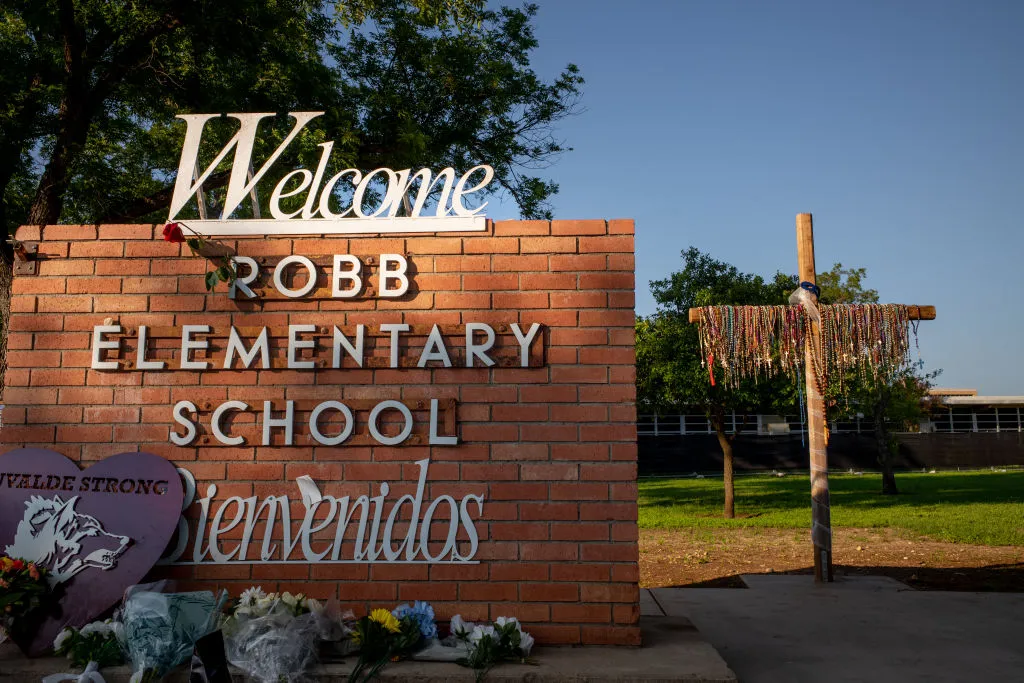 Photo: Robb Elementary School, via d.ibtimes.com
In Texas, where Uvalde occurred, the state legislature responded not by restricting access to the AR-style rifle used in the attack but by appropriating $400 million for school hardening and security infrastructure. The money flowed to the same vendors that had been marketing their products to Texas school districts for years. In the fiscal year following Uvalde, several school safety companies reported their strongest sales quarters on record.
This is the closed loop at the center of the grief industrial complex: mass shootings generate political pressure, political pressure is channeled away from prevention and toward security spending, security spending flows to an industry that has no interest in seeing its market disappear, and the cycle continues.
The Strongest Counter-Argument — and the Evidence Against It
Defenders of the school safety industry will argue, not unreasonably, that in the absence of meaningful gun legislation, schools have a responsibility to protect students with whatever tools are available. This is not an indefensible position. If the political system is unwilling to address the supply of weapons, some form of mitigation is better than none.
But this argument has a structural flaw: the security industry and the gun lobby are not separate forces pulling in opposite directions. They are components of the same political economy. Many of the same donor networks that fund opposition to gun regulation also fund the political campaigns of legislators who vote to increase school security spending. The safety industry does not lobby against gun control because it is ideologically committed to the Second Amendment. It is largely indifferent to the constitutional debate. It lobbies for security contracts because security contracts are its revenue. The result is a coalition of financial interests — gun manufacturers, ammunition retailers, security technology companies, training consultants — that is structurally aligned against the policy changes that would most effectively reduce the violence driving all of their businesses.
Who Bears the True Cost
The human cost of this arrangement is not evenly distributed. Black and Latino students in urban school districts are more likely to attend schools with heavy security infrastructure — metal detectors, surveillance cameras, school resource officers — and less likely to have access to counselors, mental health services, or the academic enrichment programs that research consistently identifies as genuine protective factors against violence. The security apparatus in these schools does not make students safer in any documented way. It does make them more likely to be arrested for behavioral infractions, feeding directly into the school-to-prison pipeline that progressive advocates have documented extensively.
For students in suburban and rural schools, the active shooter drill has become a rite of passage — a ritual normalization of the possibility of mass death that no previous generation of American children was asked to perform. The psychological literature on adverse childhood experiences is unambiguous: repeated exposure to fear-based scenarios, even simulated ones, produces measurable and lasting harm. We are conducting a national experiment in childhood trauma and calling it safety policy.
The Market That Should Not Exist
Australia did not build a school shooter drill industry after the 1996 Port Arthur massacre. It passed comprehensive gun legislation within weeks, bought back more than 650,000 weapons, and has not experienced a mass shooting of comparable scale since. New Zealand did not develop a bulletproof backpack market after the 2019 Christchurch attacks. It banned military-style semi-automatic weapons within days. The United Kingdom, Canada, Germany, Japan — none of these countries have a meaningful school safety industry, because none of them have accepted mass shootings as a permanent, unresolvable feature of civic life.
The school safety market exists in America not because the problem is uniquely insoluble but because the political will to solve it has been systematically purchased and suppressed. Every dollar spent on a surveillance camera in a school hallway, every contract signed with an active shooter training company, every bulletproof backpack sold to a terrified parent is a monument to that suppression — a reminder that in America, the grief of children has a market value, and the people collecting it have every reason to ensure the supply continues.
The only honest response to the grief industrial complex is to dismantle the political infrastructure that makes it profitable — because a society that has learned to monetize the murder of its children has made a choice, and it is long past time to make a different one.