Guilty Until Proven Wealthy: How the Plea Bargain System Became a Class-Based Coercion Machine
The Courtroom You'll Never See
More than 97% of federal convictions and roughly 94% of state convictions in the United States are resolved through plea bargains — agreements in which a defendant waives their constitutional right to trial in exchange for a reduced charge or lighter sentence. On paper, this sounds like a practical compromise that keeps an overburdened court system functional. In practice, it is one of the most efficient mechanisms of class-based coercion in American public life, and it operates almost entirely in the dark.
The Sixth Amendment guarantees every American accused of a crime the right to a speedy and public trial, the right to confront witnesses, and the right to be judged by a jury of their peers. These are not minor procedural guarantees. They are the foundational safeguards against state power run amok. Yet for the overwhelming majority of defendants — disproportionately poor, disproportionately Black and Latino, disproportionately unrepresented by adequate counsel — that right has become a theoretical abstraction, a constitutional promise that exists in the text of the law but not in the lived experience of the accused.
The Architecture of Coercion
To understand how plea bargaining became a coercion machine, you have to understand the three interlocking pressures that prosecutors wield before a single word is spoken in a courtroom.
The first is overcharging. Prosecutors routinely file the most severe charges the facts can plausibly support — and sometimes charges the facts barely support at all. This is not an accident. It is a deliberate negotiating tactic. By stacking charges and inflating exposure, prosecutors create an enormous sentencing gap between what a defendant faces at trial and what they can secure through a plea. A defendant charged with five counts who could be sentenced to forty years is not making a free choice when they accept a deal offering three years. They are calculating survival odds under duress.
The second pressure is mandatory minimum sentencing. Congress and state legislatures have, over decades of tough-on-crime political posturing, stripped judges of discretion and locked in floor sentences that prosecutors can deploy as leverage. The threat is explicit: go to trial and lose, and the judge has no choice but to send you away for a decade or more. Accept the plea, and the prosecutor will drop the mandatory-minimum charge entirely. The American Civil Liberties Union has documented how mandatory minimums have effectively transferred sentencing power from neutral judges to prosecutors whose incentives are aligned with conviction rates, not justice.
The third — and perhaps most devastating — pressure is pretrial detention. The United States incarcerates more than 400,000 people on any given day who have not been convicted of any crime. They are awaiting trial, unable to afford bail. Research by the Arnold Foundation found that low-risk defendants detained pretrial were four times more likely to be sentenced to incarceration than their released counterparts, and were significantly more likely to accept a guilty plea — even when innocent — simply to end their detention and return to their families, their jobs, and their lives. Innocence is not a sufficient defense against the grinding reality of sitting in a jail cell for months waiting for a trial date.
The Wealthy Defendant's Entirely Different Experience
Contrast that architecture with the experience of a wealthy defendant. Private counsel with the resources to file motions, challenge evidence, and demand full discovery changes the calculus of prosecution entirely. Prosecutors who know a case will be fought aggressively — by attorneys who will expose investigative shortcuts, challenge lab results, and cross-examine witnesses with genuine skill — are far more likely to offer favorable deals or decline to pursue charges at all.
This is not speculation. A 2020 analysis by the Quattrone Center for the Fair Administration of Justice at the University of Pennsylvania found that representation quality was among the strongest predictors of case outcome, independent of the underlying facts. Defendants with private counsel consistently received shorter sentences and more favorable plea terms than those represented by overworked public defenders carrying caseloads that can exceed 500 active cases at a time.
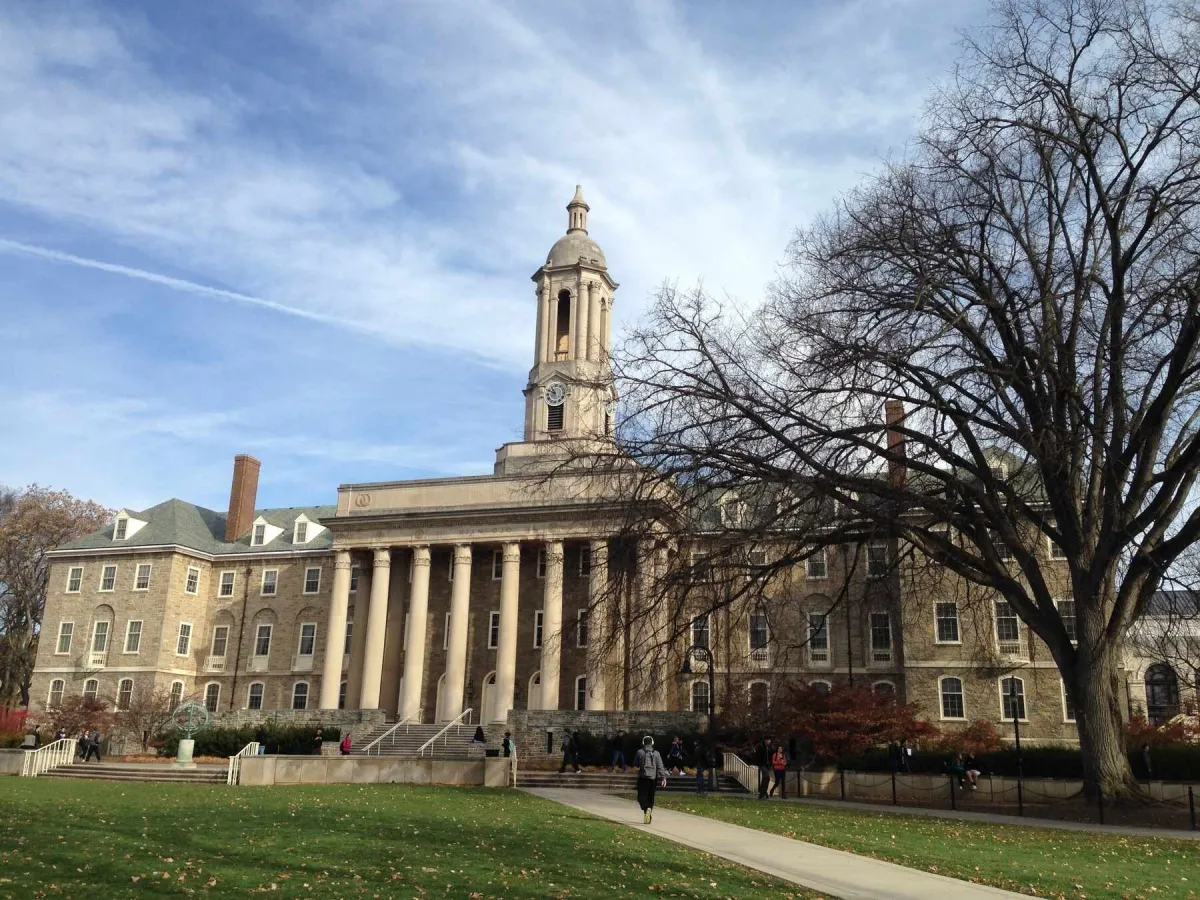 Photo: University of Pennsylvania, via ohmyfacts.com
The American Bar Association has repeatedly found that public defender offices in most jurisdictions are so severely underfunded that constitutionally adequate representation is structurally impossible. The right to counsel guaranteed by Gideon v. Wainwright in 1963 has never been adequately funded. It remains, in many jurisdictions, a right without a resource.
The Innocence Problem
The most disturbing dimension of this system is what it does to the innocent. The Innocence Project, which uses DNA evidence to exonerate wrongful convictions, has documented hundreds of cases in which defendants pleaded guilty to crimes they did not commit. The reasons are rational, not irrational: facing a trial with inadequate representation, a stacked charge sheet, and the prospect of decades behind bars, accepting a plea for time served or a short sentence is not a confession of guilt. It is a survival calculation made under conditions of state-imposed duress.
In a landmark 2012 ruling, Missouri v. Frye and Lafler v. Cooper, the Supreme Court acknowledged that plea bargaining is not a peripheral feature of the criminal justice system — it is the criminal justice system. Yet the Court has done almost nothing to regulate the conditions under which pleas are extracted, leaving intact a framework that systematically advantages those with resources and punishes those without them.
Who Bears the Weight
The human cost of this system falls with crushing precision on specific communities. Black Americans are incarcerated at five times the rate of white Americans, according to the NAACP. Latino defendants face similar disparities. Low-income defendants — regardless of race — are exponentially more likely to be held pretrial, more likely to receive inadequate representation, and more likely to accept plea deals under conditions that no reasonable person would describe as voluntary.
This is not a series of unfortunate coincidences. It is the predictable output of a system that uses prosecutorial discretion as an unregulated axis of class power, one where the decision of whether to charge, what to charge, and what to offer in a deal rests almost entirely with individual prosecutors who face no meaningful accountability for the disparities their choices produce.
What Accountability Would Actually Look Like
Reformers have proposed concrete interventions: mandatory recording and disclosure of plea offers, prosecutorial data transparency requirements that track charging decisions by race and income, robust funding for public defender offices that actually meets constitutional minimums, and the elimination of mandatory minimums that strip judicial discretion and hand it to the least accountable actors in the system.
The strongest counterargument from prosecutors and their defenders is pragmatic: the court system simply cannot handle a world in which every defendant exercises their trial right. That argument is correct as a description of the current system's capacity. It is not a defense of the system — it is an indictment of a justice infrastructure so deliberately underfunded and overloaded that coercion has become the only mechanism keeping it from collapse.
A justice system that depends on the poor waiving their constitutional rights to remain operational is not a justice system. It is a processing facility.
The Verdict the System Never Delivers
The plea bargain pipeline does not merely produce individual injustices — it produces a political economy of criminal justice in which mass incarceration is self-sustaining. Every coerced plea is a conviction that bolsters a prosecutor's record, justifies a department's budget, and adds another body to a prison population that private corrections companies and rural economies have come to depend on. The incentives are perfectly misaligned with justice and perfectly aligned with the perpetuation of the system itself.
Reforming this will require more than goodwill. It will require electing prosecutors who measure success by equity and accuracy rather than conviction rates, funding public defense at levels that make the Sixth Amendment real rather than theoretical, and dismantling the mandatory minimum regime that has handed unchecked power to the least transparent actors in American law.
The constitutional right to trial by jury belongs to every American — and until every American can actually afford to exercise it, justice in this country remains a commodity, not a guarantee.