Hired Guns and Hurricane Season: The Quiet Privatization of America's Emergency Response

Photo of Greg Abbott, via Wikimedia Commons
When the Badge Belongs to a Corporation
In the summer of 2023, as wildfires tore through Hawaii and floodwaters swamped communities across the South, something largely unreported was happening at the edges of America's emergency response infrastructure. Private security contractors — firms with names unfamiliar to most voters but well-known to defense procurement offices — were operating alongside, and in some cases directing, operations that have historically been the exclusive domain of state National Guard units. This is not a hypothetical threat on the horizon. It is a structural shift already underway, accelerating with each new crisis, and almost entirely invisible to the public that pays for it.
The National Guard, established under the Militia Acts and codified in the National Defense Act of 1916, exists as one of the most constitutionally grounded institutions in American civic life. It answers to governors in peacetime, to the President in federal emergencies, and — critically — to the public chain of command at every level. Its soldiers are citizen-soldiers: neighbors, teachers, and tradespeople who drill on weekends and deploy when communities need them. They are accountable to elected officials, subject to military law, and governed by rules of engagement that, however imperfect, exist within a democratic framework.
Private security contractors answer to shareholders.
The Contractors Are Already Here
The most visible recent example came through Operation Lone Star, Texas Governor Greg Abbott's ongoing border security initiative, which has cost Texas taxpayers more than $11 billion since 2021 according to the Texas Tribune. Alongside National Guard deployments, private contractors have been engaged for surveillance technology, transportation logistics, and detention support functions. In Florida, Governor Ron DeSantis has similarly leaned on private vendors for components of his state's immigration enforcement operations, blurring the line between public safety and outsourced enforcement.
Beyond immigration, the pattern repeats in disaster response. After Hurricane Ian devastated Southwest Florida in 2022, private firms including debris-removal contractors with opaque subcontracting chains were deployed before full federal and state coordination was established — a dynamic that FEMA's own after-action reviews have flagged as a source of accountability gaps. The problem is not that private firms participate in disaster recovery. It is that their increasing operational role — particularly in security functions — strips away the oversight mechanisms that protect civilians.
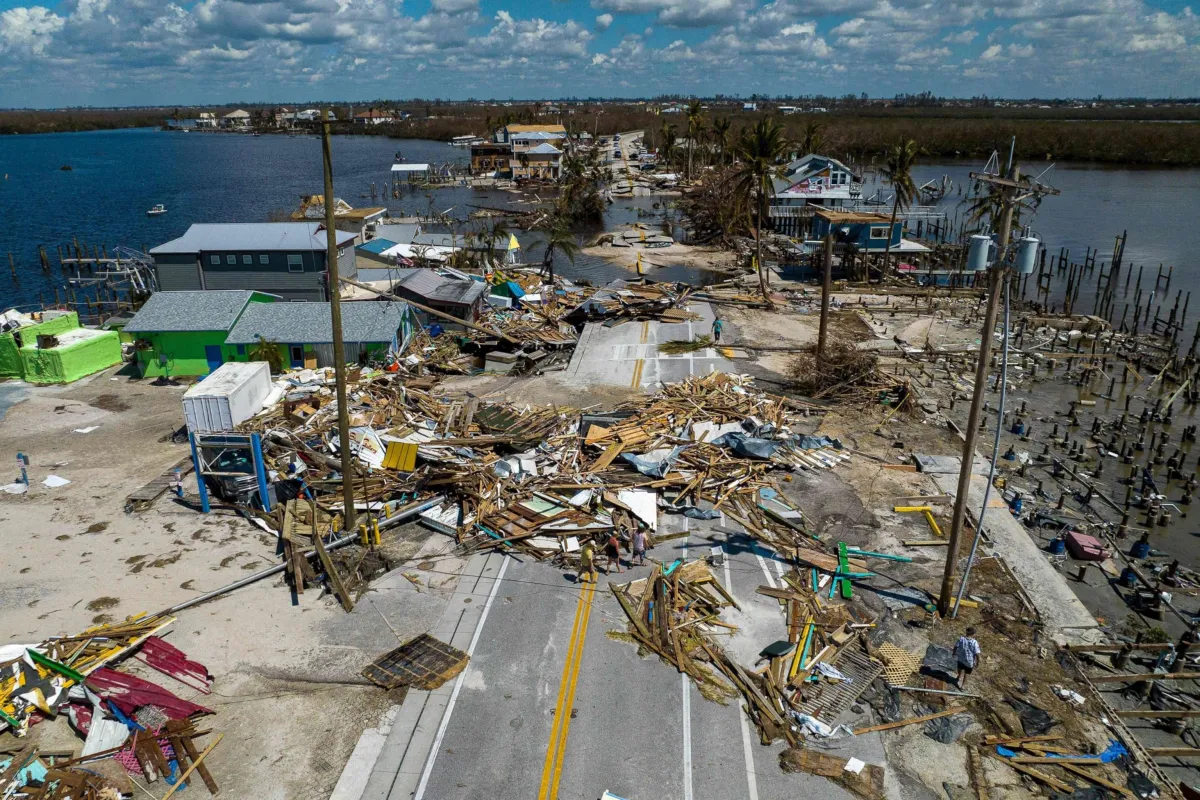 Photo: Hurricane Ian, via i.abcnewsfe.com
This matters because private security contractors are not subject to the Posse Comitatus Act, which limits the use of federal military forces in domestic law enforcement. They are not subject to the Uniform Code of Military Justice. When a National Guard soldier uses force inappropriately, there is a legal and institutional apparatus — however flawed — designed to hold them accountable. When a private contractor does the same, the primary recourse is a civil lawsuit against a limited liability corporation that may dissolve, restructure, or invoke contract indemnification clauses before a case ever reaches trial.
Profit Motive Meets Category 4
The strongest argument for private contractor involvement is operational capacity. Guard units are stretched thin. Recruitment has declined — the Army National Guard missed its fiscal year 2023 recruiting goal by roughly 10 percent, according to Department of Defense data — and the pace of deployments, from COVID-19 response to border operations to civil unrest, has accelerated. When a governor faces a catastrophic storm and her Guard is already deployed elsewhere, the argument for private supplementation has surface-level appeal.
But this argument collapses under scrutiny. The capacity crisis in the Guard is itself a product of policy choices: underfunded recruitment incentives, inadequate mental health support for returning service members, and the political decision to deploy Guard units for operations — particularly extended border missions — that were never part of their core mandate. Governors who have most aggressively deployed Guard units for political border theater are the same governors now pointing to Guard exhaustion as justification for private contractor expansion. The problem and the proposed solution share the same author.
More fundamentally, the profit motive is structurally incompatible with emergency response. Private security firms have a financial incentive to prolong engagements, expand their operational footprint, and minimize liability exposure. A National Guard unit's mission ends when the community is safe. A contractor's revenue stream ends when the contract does. These are not the same objective.
Who Bears the Risk
The communities most exposed to this shift are, predictably, those with the least political leverage. Rural counties hit by flooding or tornadoes. Urban neighborhoods placed under curfew during civil unrest. Border communities where enforcement operations blend into daily life. In each of these contexts, the people most likely to encounter private security personnel operating in quasi-governmental roles are low-income, disproportionately Black and Latino, and least equipped to navigate the legal labyrinth required to seek accountability when something goes wrong.
The 2020 civil unrest following George Floyd's murder offered a preview. In several cities, private security firms were contracted by businesses and, in some cases, coordinated informally with law enforcement in ways that were never publicly disclosed. The accountability gap was immediate and real. Incidents involving private personnel were systematically harder to investigate, prosecute, or even document than those involving sworn officers — and sworn officer accountability was already inadequate.
 Photo: George Floyd, via media.cnn.com
The Democratic Stakes
This is, at its core, a question about who controls the legitimate use of force in a democratic society. The National Guard is an imperfect institution — its history includes the Kent State massacre and the suppression of labor organizing — but it is a public institution, subject to elected oversight, public records laws, and constitutional constraints. The creeping privatization of its functions does not improve on those imperfections. It simply removes the democratic architecture through which imperfections can be challenged and corrected.
As climate change guarantees more frequent and severe disasters, as political pressure mounts on border operations, and as civil unrest remains a feature rather than a bug of a deeply unequal society, the demand for emergency response capacity will only grow. The question is whether that capacity will be organized around public accountability or private profit.
America cannot afford to answer that question wrong — and the communities that will suffer most from the wrong answer are already the ones the system has failed the longest.
The privatization of emergency response is not an efficiency upgrade — it is a transfer of democratic authority to entities that were never designed to hold it, and the public has a right to demand that transfer stop.